BBC Domesday
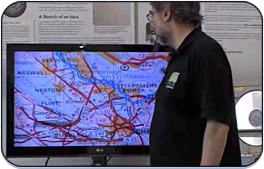
The BBC Domesday Project celebrated the 900th anniversary of the original Norman Domesday survey of 1066. The modern version was a snapshot of life in Britain in the mid 1980s. It was released in 1986 on laser disc with maps, stories and photos from the community groups and the 9000 schools which took part. The use of maps, photos and details about communities was not unlike the way Google maps works today but the Domesday project was conceived before the internet gave easy access to material of this kind. The laser disc could hold 300mb on each side. Although laser disc technology quickly became obsolete it was the best available technology of the day to deliver large amounts of data including, for the first time, multi-media video and graphical images. The photos on the disc were analogue, not digital – it predates the JPEG standard for digital still photos by some 5 years.
Input
BBC Domesday System
Output
BBC Domesday System
Storage - Laserdisc
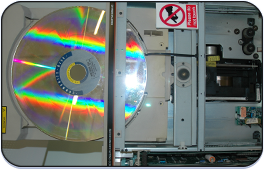
In the mid 1980s the BBC wanted users to be able to view films in a convenient and accessible format. They chose the interactive laser disc - an optical disc for storing movies and data. A laser disc player could be used as a peripheral device connected to the BBC computer and the material could be accessed from the computer. The quality the images and sound was very good. The laser disc player was a forerunner of today's DVD players. The BBC laser disc player held the data on two sides of the large disc and, if used to view a movie, the disc had to be turned over half way through.
Memory
BBC Domesday System
Processing
BBC Domesday System
User Interface
BBC Domesday System
Impact on Society - BBC Domesday preservation
The laser discs used for the BBC Domesday Project in 1986 deteriorated over time. Damp, which degrades the reflective layers that store information, is a particular hazard. Data in its laser disc analogue format could be lost after only 25 years. The original Domesday survey, written on parchment made of sheep skins has lasted 900 years. It reminds us that whatever media we use today to store data will fail at some point. Recovery of that data in the future could be very difficult unless the data is transferred and backed up to newer digital media while it can still be read.
Although the contents of the disc were in analogue format the data from the project has been digitised and copied onto a more modern format. It can still be accessed on the BBC website Domesday Reloaded.
left

BBC Domesday preservation
Running time: 01:38
right