

A History of British Computing Timeline
(featuring the computer systems and developments referenced in this resource and other key systems that make up our digital heritage)
- 1943
- 1945
- 1949
- 1949
- 1950
- 1951
- 1951
- 1956
- 1957
- 1960/1
- 1965
- 1965
- 1965
- 1974
- 1978
- 1980
- 1981
- 1985
- 1986
- 1989
- 1998
-

1943 Dec
The Colossus was built, by Dr Thomas ('Tommy') Flowers at The Post Office Research Laboratories in London, to crack the German Lorenz (SZ42) cypher. It contained about 2500 valves (vacuum tubes) for the electronic logic. Colossus read long lengths of paper tape looped around a series of pulley wheels. The tape held the coded German text in hole patterns punched on the tape. The tape was streamed in and read by an optical reader and the computer automatically tried different key settings and used logical and statistical analysis to find the key. The input rate from the tape was about 5000 characters per second (27 miles per hour) and Flowers ran the tape up to 9000 characters per second (53 miles per hour) as an experiment before the tape broke and streamed all over the floor.
Image: Colossus
-
1945 Nov
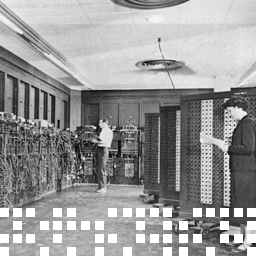
First electronic calculator ENIAC (Electronic Numerical Integrator and Computer) was designed and built by John Mauchly and Presper Eckert at the University of Pennsylvania. ENIAC was originally designed to calculate shell trajectories for the military so that gun settings could be adjusted to take account of conditions that affected accuracy such as temperature wind and ground consistency. It was designed during World War 2 but was not finished until just after the war ended.
ENIAC was vast. It had 18,000 valves, 1500 electromechanical relays and over 6000 manual switches. Programming was difficult, and a problem could take weeks to set up. But it saved months of human effort. One of the first calculations it did was for the hydrogen bomb.
ENIAC was not strictly a general purpose computer in the way we think about computers now. It was more a programmable calculator. But it was the first of its kind on such a scale. The use of so many valves in one system proved that using valves on a large scale for computation was possible. Ideas for general purpose electronic computers grew directly from the ENIAC project and these ideas remain the basis for computer design to this day.
Image: Colossus
-
1949
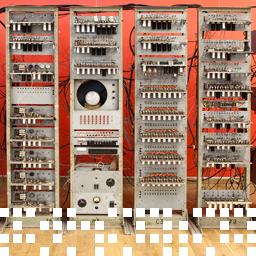
The Manchester Mark 1 was one of the earliest stored-program computers. It was developed at the Victoria University of Manchester and first ran in April 1949. The Mark 1 was a follow-on from the legendary Manchester 'Baby' which ran its first program on 21 June 1948. The Manchester 'Baby' was the first computer anywhere to automatically run a program stored in its internal memory.
The Mark 1 provided a computing resource within the university, to allow researchers to gain experience in the practical use of computers.
The computer is historically significant because of its pioneering inclusion of index registers, an innovation which made it easier for a program to read sequentially through an array of words in memory. Thirty-four patents resulted from the machine's development, and many of the ideas behind its design were incorporated in subsequent commercial products for Ferranti and IBM.
Image: Manchester Baby Replica
© The Museum of Science and Industry - Manchester
-

1949 May
(EDSAC) (Electronic Delay Storage Automatic Calculator) was the first practical electronic stored program computer to provide computing services to scientists, engineers, and mathematicians. It was designed and built by a team led by Prof. Sir Maurice Wilkes at the Mathematical Laboratory at Cambridge University. Till then computers were mostly experimental machines for development and used largely by the engineers who designed them. With EDSAC users could for the first time write their own programs and this saw the start of a new profession – computer programmer. Wilkes and his team pioneered many hardware and programming techniques that are an accepted part of practice today. EDSAC first ran in May 1949 and was switched off in July 1958.
Image: Cambridge EDSAC
Copyright Computer Laboratory, University of Cambridge. Reproduced by permission.
-
1950
Pilot ACE was a preliminary version of the full ACE for which Alan Turing produced the original design in 1946. He designed the ACE while with the government scientific establishment, the National Physical Laboratory (NPL) located in Teddington, west of central London. Turing's designs for the ACE were the first complete designs for an automatic electronic internal stored program computer.
Pilot ACE was intended as a first step towards building the much larger full-scale ACE (Automatic Computing Engine). Turing's designs were unusual: he used as little hardware as possible and made up for this with more complicated software. The trends elsewhere were in the opposite direction – to use a lot of hardware so that the programming could be simplified and therefore make the computer easier to use. Though Pilot ACE was intended mainly as an experimental test machine it was soon pressed into serious work. It first ran a simple program in May 1950 and was demonstrated with great success to the press later that year. It went into full-time use in 1952 and gave excellent service in scientific computing for many years. The design of Pilot ACE stands as proof of Turing's extraordinary originality. The construction of the machine was delayed by internal difficulties at NPL. Otherwise it would perhaps be better known.
Pilot ACE was successful and a commercial production version, the DEUCE, was produced and sold by the English Electric Company. The first DEUCE was delivered in 1955.
-
1951
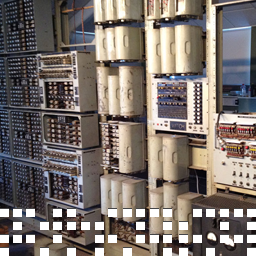
The Harwell Dekatron Computer, later known as the WITCH was built and used at the Atomic Energy Research Establishment in Harwell, Oxfordshire. It was built between 1949 and 1951 and remained operational for many years. It was used for scientific computation.
The device it used for its fast-access memory is unusual. It used Dekatron tubes – glass vacuum tubes with ten small electrodes, one for each number from 0 through 9. So it worked in decimal while almost all other computers used binary.
The WITCH has nearly 500 electromechanical relays as well as many valves. Relays are much slower than electronic valves and the WITCH was not particularly fast. But what it lacked in speed was made up for by its legendary reliability – it would churn on for days without breaking down.
The WITCH has been restored to working order at The National Museum of Computing, at Bletchley Park. It is the oldest known working electronic computer anywhere.
Image: WITCH Computer System
-
1951
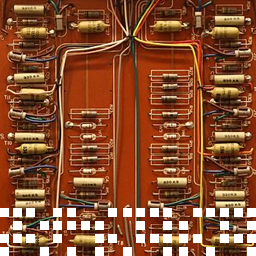
The LEO I (Lyons Electronic Office I)was the first computer used for commercial business applications. It was modelled closely on the Cambridge EDSAC, and ran its first business application in 1951. LEO Computers eventually became part of English Electric Company) and then International Computers Limited (ICL) and ultimately Fujitsu. LEO series computers were still in use until 1981.
LEO helped manage daily orders for the chain of Lyons tea shops. LEO was used to calculate the overnight production requirements, assembly instructions, delivery schedules, invoices, costings, and produce management reports. This was the first instance of an integrated management information system plus a computerised call centre. The LEO project was also a pioneer in outsourcing: in 1956, Lyons started doing the payroll calculations for Ford UK and others on the LEO I machine. Later, the system was used for scientific computations. Met Office staff for example used a LEO I.
Image: LEO I
-
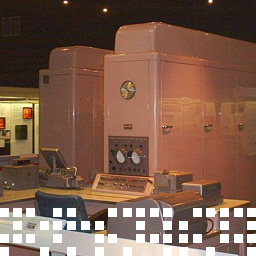
1956
The Pegasus 1 was Ferranti's most popular valve (vacuum tube) computer. In 1956 the first Pegasus was used to calculate the stresses and strains in the tail plane of an aircraft; the results were used to check the manufacturer's figures. In 1957 a Pegasus computer was used to calculate 7480 digits of pi, a record at the time.
At least two Pegasus machines survive, one in The Science Museum, London and one in The Manchester Museum of Science and Industry. The Pegasus in the Science Museum ran its first program in December 1959 and has been regularly demonstrated. It was the oldest working digital electronic computer in the world until 2012 when the restoration of the WITCH computer was completed at the National Museum of Computing at Bletchley Park.
The Ferranti Pegasus was one of the earliest production computers and signalled the emergence of computers from the lab to the work place – the transition from small, expensive experimental machines that required a team of specialist engineers and programmers to run it, to a machine that could take its place in an office and be run by its users.
Image: Ferranti Pegasus
-
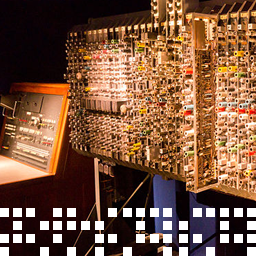
1957
The Automatic Computing Engine (ACE) was an early electronic stored-program computer designed by Alan Turing at the Mathematics Division of the National Physical Laboratory (NPL), in Teddington, West London. The use of the word Engine was in homage to Charles Babbage and his Difference Engine and Analytical Engines. Turing's technical report of 1946 contained the detailed design of a complete automatic electronic computer, the ACE. The design was more complete and advanced than anything elsewhere. Turing's designs were unusual in that they used as little hardware as possible and made up for this with more complicated programs. The trends elsewhere were in the opposite direction – to use a lot of hardware so that the programming could be simplified and therefore make the computer easier to use.
The full-scale ACE computer was completed after Turing had left NPL to go to Manchester. It was completed at NPL in 1957 and it saw service from 1958 through to 1967. The design was remarkable and unique. It was the last government-funded attempt at a 'British National Computer'.
Image: NPL ACE
-

1960/1
The Elliott 803 computer was designed and built.
Image: Elliott 803
-

1965
The IBM 1130 Computing System was introduced.
Image: IBM 1130
-

1965
The PDP-8 computer, the first business personal computer is launched.
Image: PDP-8
-

1965
The Elliott 903 Computer was designed and built.
Image: Elliott 903
-

1974
The ICL 2966 Mainframe computer was launched.
Image: ICL 2966
-

1978
The first Laserdisc is avilable for business and domestic users.
Image: Laserdisc
-
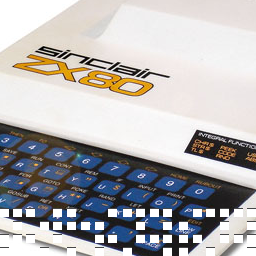
1980
Sinclair's ZX80 personal computer brought computing into the home in an affordable package.
Clive Sinclair launched the ZX80 home computer in 1980, and the ZX81 the next year. Each was available in kit form or ready-built for under £100. The ZX Spectrum followed soon after and was a big success.
Sinclair's ZX-series computers were the first small low-cost personal home computers and played a big part in accelerating the widespread use of computers by the general public. The circuit designs were sometimes not conventional but he brought electronics consumer products within the reach of millions and did a great deal to raise public perception of computing.
Image: Sinclair ZX80
-
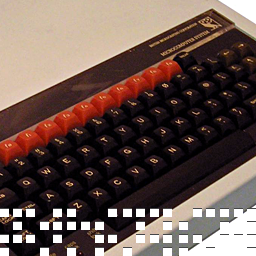
1981
BBC microcomputer targeted mainly at the education market, was launched in a government-backed drive to encourage an interest in, and increase knowledge of, computer programming in schools.
The introduction of the 'BBC Micro' was a farsighted attempt to increase computer literacy in the general public and especially in schools. At its peak some 80% of schools used them. The ARM processor is developed to support the Acorn Archimedes series of computers that were to follow the Acorn BBC computer. The latest generation of ARM processors are now used in over 95% of smartphones, as well as in mobile computers and televisions.
Image: BBC microcomputer
-
1985
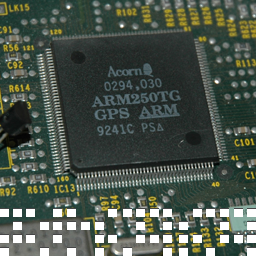
The first ARM processor was created.
ARM processors are fast and efficient processors in a single chip. They consume less power than other processors and that makes them attractive for mobile use as in smartphones and tablets.
ARM originally stood for Acorn RISC Machines. RISC stands for Reduced Instruction Set Computer. This is all a bit confusing. The point of is that the processor is so effective because it only uses a limited number of instructions that it can execute very quickly. So it is fast and consumes very little power.
Image: ARM processor
-
1986
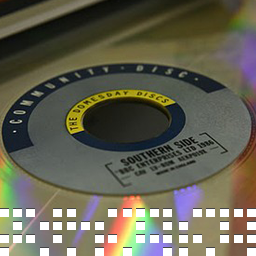
The BBC Domesday project is published for schools to buy
Image: BBC Domesday
-
1989
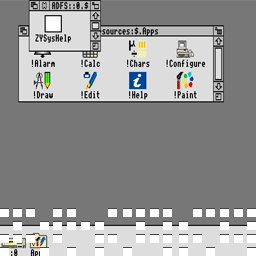
Acorn's A3000 computer using the Acorn RISC OS system is launched mainly for the education market.
Image: Acorn RISC OS
-

1998
The launch of the Acorn Phoebe personal computer was cancelled due to the competition from the growth in the use of IBM compatible PC computers using the Microsoft 'DOS' operating system.
Image: Acorn Phoebe computer


